
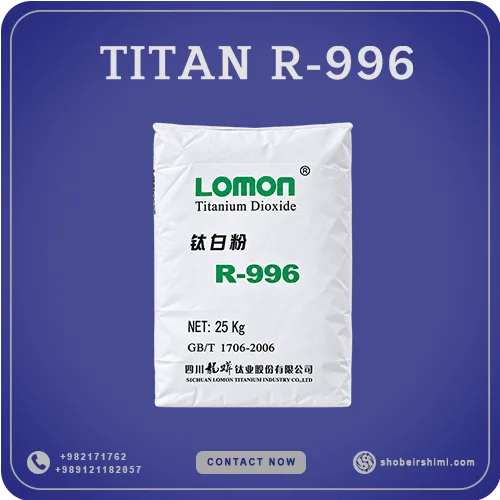
- Commercial grade: BILLIONS R-996, also searched as R996.
- Manufacturer: LB Group.
- Material: Rutile titanium dioxide pigment.
- Production route: Sulfate process.
- Surface modification: Alumina, zirconia and organic treatment.
- Application focus: Industrial, powder and architectural coatings.
R996 Titanium Dioxide
Description
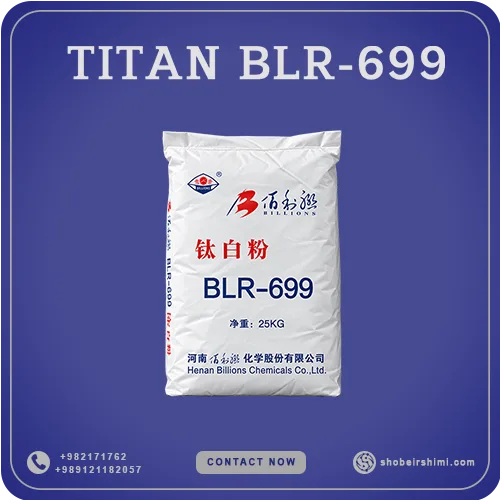
BILLIONS™ R-996 is a sulfate-process rutile titanium dioxide pigment from LB Group. Treated with zirconia and alumina, it is designed for coating applications requiring opacity, durability, gloss and dispersion. The manufacturer recommends it for industrial, powder, and interior and exterior architectural coatings.
Shobeir Shimi is an international trading company and supplier of industrial raw materials. Contact our team to discuss R996 titanium dioxide, request technical documentation and obtain a quotation based on your required quantity and delivery destination.
Selecting R996 for Your Coating System
A pigment specification is a starting point for selection. The purchasing decision should reflect how the material performs in the finished coating at the required film thickness, appearance and production cost.
When assessing R996, define the result you need before comparing samples. A high-gloss industrial finish, a decorative wall paint and a powder coating may require different evaluation procedures, even when they use the same white pigment.
Compare candidate formulations against an approved reference. Keep the binder, additives, pigment loading and application conditions consistent during the first trial. This makes differences easier to interpret and helps avoid attributing a formulation change entirely to the pigment.
Applications and Evaluation Priorities
Industrial Coatings
For an industrial coating, assess the pigment in the intended resin system and under the actual curing conditions.
Check opacity, shade and gloss at the specified dry film thickness. Include the substrate and application method used in production, because a laboratory drawdown alone may not represent the final finish.
Where the coating has additional requirements, such as chemical resistance or adhesion, test the complete formulation. Those properties should not be inferred from the pigment description.
Powder Coatings
For powder coating development, carry the comparison through the complete process: premixing, extrusion, grinding, application and curing.
Evaluate the cured panels for colour, coverage, gloss and surface appearance. Keep film thickness and cure conditions comparable between samples. If the pigment is being introduced into an established product, confirm that the formulation still meets the existing acceptance criteria.
Interior Architectural Coatings
For interior paints, compare coverage and colour at the intended application rate. Assess the finish in the relevant gloss category rather than assuming that a result obtained in one formulation transfers to another.
Where washability or scrub resistance matters, include it in finished-paint testing. The pigment is one component of a system that also includes the binder, extenders and additives.
Exterior Architectural Coatings
For exterior formulations, use an exposure or accelerated-weathering programme appropriate to the intended service conditions.
Evaluate colour and gloss retention alongside other coating requirements. A material change should be approved against the coating’s performance targets, with the binder system and application conditions included in the assessment.
R996 Titanium Dioxide Technical Data
The manufacturer presents the following properties as typical, except for the explicitly stated moisture maximum.
| Property | Value | Test Method / Reported Basis |
|---|---|---|
| TiO₂ content | 95% — typical | XRF |
| Inorganic coating | Alumina, zirconia | — |
| Organic treatment | Present | — |
| Moisture when packed | 0.5% maximum | ISO 787-2 |
| Tamped bulk density | 1.2 g/cm³ — typical | ISO 787-11 |
| Oil absorption | 18 g/100 g — typical | ISO 787-5 |
| pH | 7.0 — typical | ISO 787-9 |
| Density | 4.1 g/cm³ — typical | ISO 787-10 |
| ISO 591 classification | R2 | — |
| CAS number | 13463-67-7 | — |
| Colour Index | Pigment White 6 | — |
Typical values describe the grade’s general characteristics. They should not be converted into contractual acceptance limits without an agreed specification.
Dispersion and Formulation Trials
For liquid coatings, establish a trial procedure that records the addition sequence, dispersant package, mixing conditions and dispersion endpoint. Compare the finished paint as well as the initial pigment dispersion.
Useful checks include fineness of grind, viscosity, opacity, colour and storage behaviour. Review the results together: reaching an acceptable grind does not by itself demonstrate that the finished coating meets its appearance requirements.
For powder coatings, use a trial suited to melt processing and cured-film evaluation. This page does not prescribe a universal pigment loading, milling time or extrusion setting. Determine those conditions for the formulation and equipment in use.
Packaging, Storage and Documents
Manufacturer packaging options include 25 kg bags and flexible intermediate bulk containers. Confirm the format available for your order.
Store indoors, protected from moisture and temperature extremes, and use stock on a first-in, first-out basis.
Request the applicable documents during procurement:
- TDS: Product description and technical properties.
- COA: Reported results for the identified batch.
- SDS: Safety, handling and storage information.
Match the grade designation and batch details to the offered material. Confirm any special documentation requirements before finalising the order.
R996 Titanium Dioxide Price and Supply
An R996 titanium dioxide price inquiry should specify the quantity, packaging, destination and preferred delivery terms. These details define the scope of the quotation and make competing offers easier to compare.
For formulation economics, also consider the pigment loading required to achieve the target result, processing effort and finished-product acceptance. Unit price alone does not establish the cost of an approved coating.
Shobeir Shimi can review your sourcing inquiry and provide the relevant commercial details. Availability, minimum order quantity, payment terms and dispatch timing are confirmed for each quotation.
Frequently Asked Questions
What should I check before choosing R996?
Start with your coating type, binder system, finish and performance requirements. Review the applicable TDS, then compare the material with your current pigment in a controlled formulation trial.
Are the technical values guaranteed batch results?
No. Most values shown are manufacturer typical properties. A COA reports results for a particular batch, while the agreed specification defines the applicable acceptance requirements.
Can R996 replace another titanium dioxide grade?
It can be evaluated as a candidate. Confirm colour, opacity, gloss, dispersion and end-use performance before approving a substitution.
How much pigment should I use?
There is no single loading suitable for every coating. Determine the addition level through formulation trials using the required coverage, film thickness, finish and cost targets.
Can I request a TDS, COA and SDS?
Include these documents in your inquiry. Specify the batch number if known, and confirm document availability for the material being offered.
What information is needed for a quotation?
Provide the exact grade, quantity, application, packaging preference and delivery destination. Include any mandatory technical limits or purchasing conditions.
Request a Quote for BILLIONS R-996
Send your material requirements to Shobeir Shimi to request pricing, technical documentation and supply details.
Reviews
There are no reviews yet.