

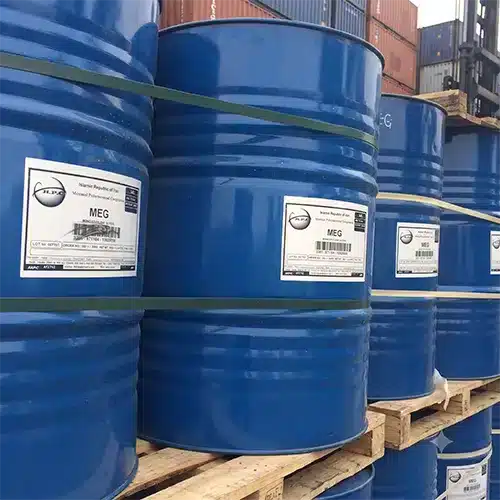

- High-purity Monoethylene Glycol (MEG) with 99.8% minimum purity
- Supplied directly from leading Iranian petrochemical producers
- Suitable for PET resin, polyester fiber, antifreeze, coolants, and industrial applications
- Available in bulk, 220 L drums, 1-ton IBC tanks, and flexi tanks
- Export-ready with COA, TDS, and international shipping documents
- Competitive pricing for both domestic and international customers
- Fast quotation and worldwide export support
- Contact our sales team via WhatsApp to receive the latest Monoethylene Glycol (MEG) price based on your required quantity, packaging, and destination.
Monoethylene glycol (MEG)
Description
Monoethylene Glycol (MEG) Price in Iran
Buyers searching for the current Monoethylene Glycol (MEG) price are usually looking for more than a single number — they need a supplier who can back that number with consistent quality, reliable volumes, and export-ready documentation. MEG is one of the most widely traded petrochemical intermediates in the world, forming the backbone of the polyester, PET packaging, and antifreeze industries. Its price movements ripple through dozens of downstream sectors, which is why sourcing from a stable, well-connected supplier matters as much as the quoted figure itself.
Shobeir Shimi International Trade Co. LTD supplies high-purity Monoethylene Glycol sourced from leading Iranian petrochemical producers, giving international buyers direct access to competitively positioned MEG grades suitable for polyester, PET, and industrial applications. As a trading and export company — not a manufacturer — Shobeir Shimi works closely with established Iranian producers to secure consistent supply and route it efficiently to global markets.
MEG pricing is never static. It moves with a combination of factors, including:
- Ethylene feedstock prices, since MEG is derived from ethylene oxide
- Crude oil fluctuations, which influence feedstock and energy costs across the petrochemical chain
- Global supply and demand balances, particularly shifts in Asian polyester demand
- Order quantity, with bulk purchases typically achieving more favorable terms
- Packaging type, as drums, IBC tanks, flexi tanks, and bulk shipments carry different logistics costs
- Freight costs, which vary by route, vessel availability, and season
- Destination market, including import duties, port handling, and regional demand
Because these variables shift regularly, Shobeir Shimi does not publish fixed prices. Instead, buyers are encouraged to request the latest MEG quotation tailored to their specific quantity, packaging preference, and destination port — ensuring pricing that reflects real-time market conditions rather than outdated figures.
What is Monoethylene Glycol (MEG)?
Monoethylene Glycol, with the chemical formula C₂H₆O₂, is one of the simplest and most commercially important members of the glycol family. It is produced industrially through the hydrolysis of ethylene oxide, itself derived from ethylene — one of the core building blocks of the petrochemical industry. This production pathway links MEG pricing closely to upstream ethylene markets, which is why feedstock costs are a central factor in every quotation.
Physically, MEG appears as a clear, colorless, and transparent liquid with a mild odor. It is fully miscible with water and many organic solvents, a property that makes it exceptionally versatile across industrial formulations. MEG also exhibits a low freezing point and a relatively high boiling point compared to water, which is precisely why it performs so effectively in both cold-weather antifreeze systems and high-temperature heat transfer applications.
Within petrochemical value chains, MEG serves as a critical intermediate rather than a finished consumer product. Its largest global demand driver is polyester production — specifically PET resin for packaging and polyester fiber for textiles — where MEG reacts with purified terephthalic acid (PTA) to form long polymer chains.
For these polymer-grade applications, purity is non-negotiable. Trace impurities such as diethylene glycol (DEG), water, or aldehydes can interfere with polymerization reactions, discolor finished polymer, or weaken fiber and resin performance. This is why polyester manufacturers and PET resin producers consistently prioritize high-purity MEG — typically 99.8% minimum — over lower-grade alternatives, even at a modest price premium.
Technical Specifications of Monoethylene Glycol
For industrial buyers, technical specifications are not a formality — they are the basis for compatibility testing, process qualification, and long-term supplier trust. A polyester producer, for instance, cannot risk variability in DEG content, since even small deviations can affect polymer color and molecular weight distribution. Similarly, antifreeze formulators depend on tight control of water content and acidity to ensure consistent freeze protection and corrosion resistance.
Shobeir Shimi supplies MEG accompanied by full technical documentation so that buyers can verify every relevant parameter before committing to an order. Key quality parameters typically assessed include:
- Purity (wt%)
- Water content
- DEG (diethylene glycol) content
- Color (Pt-Co scale)
- Specific gravity
- Acidity
- Iron content
- Chlorides
- Aldehyde content
| Property | Value |
|---|---|
| Appearance | Colourless, transparent |
| Purity | 99.8 wt % min |
| Colour (Pt-Co) | 5 max |
| DEG | 0.08 wt % max |
| Water | 0.08 wt % max |
| Specific gravity, 20/20 °C | 1.1151 – 1.1156 |
| 5% vol | Min. 196 °C |
| 95% vol | Max. 199 °C |
| Aldehydes (as formaldehyde) | 8 mg/kg max |
| Acidity (as acetic acid) | 10 mg/kg max |
| Iron (as Fe) | 0.1 mg/kg max |
| Inorganic chlorides (as Cl) | 0.05 mg/kg max |
| Ash | 50 mg/kg max By Req=10 mg/kg max |
Complete specification sheets, including exact values for each parameter, are available on request and accompany every shipment through official Technical Data Sheets and Certificates of Analysis.
Key Features of High-Purity Monoethylene Glycol
High Purity Performance
At a minimum purity of 99.8 wt%, this MEG grade is suited to demanding polymer-grade applications where even trace-level impurities can affect end-product quality. High purity reduces side reactions during polymerization and helps manufacturers maintain consistent output specifications batch after batch.
Excellent Heat Transfer Properties
MEG’s thermal conductivity and stable liquid behavior across a wide temperature range make it a preferred fluid for industrial cooling and heating systems. It absorbs and transfers heat efficiently, supporting consistent performance in demanding thermal cycles.
Low Freezing Point
When blended with water, MEG significantly depresses the freezing point of the resulting solution. This property is the foundation of its role in antifreeze and coolant formulations, protecting engines and equipment from damage in cold climates.
High Boiling Point
MEG’s elevated boiling point relative to water allows it to remain stable at higher operating temperatures, reducing the risk of vapor lock or fluid breakdown in engines and industrial heat transfer loops.
Water Miscibility
Full miscibility with water gives formulators flexibility when designing coolant blends, industrial fluids, and process solutions, allowing precise control over concentration and performance characteristics.
Chemical Stability
MEG remains chemically stable under normal storage and handling conditions, supporting extended shelf life and dependable performance for buyers managing inventory across long shipping and storage cycles.
Industrial Applications of Monoethylene Glycol
PET Resin Manufacturing
MEG is a core raw material in the production of polyethylene terephthalate (PET), reacting with purified terephthalic acid to form the polymer used in beverage bottles, food packaging, and rigid plastic containers. Consistent MEG quality directly affects the clarity, strength, and processability of finished PET resin.
Polyester Fiber Production
In the textile industry, MEG combines with PTA or dimethyl terephthalate to produce polyester fiber and filament yarn. This fiber is used extensively in apparel, home textiles, and industrial fabrics, making stable MEG supply essential for textile manufacturers operating continuous production lines.
Automotive Antifreeze and Coolants
MEG is the primary active ingredient in most automotive antifreeze and coolant formulations. It lowers the freezing point of engine coolant to prevent freeze damage while also raising the boiling point to reduce overheating risk, protecting engine components across seasonal temperature extremes.
Heat Transfer Fluids
Beyond automotive use, MEG is widely applied in HVAC systems, refrigeration loops, and industrial cooling circuits, where it serves as a heat transfer medium that resists freezing and supports efficient thermal exchange.
Natural Gas Dehydration
In natural gas processing, MEG is used to absorb water vapor from gas streams, preventing hydrate formation that could block pipelines. This dehydration function protects transport infrastructure and supports safe, continuous gas flow.
Chemical Manufacturing
MEG also serves as a chemical intermediate in the production of resins, adhesives, paints, and coatings. Its reactivity and solvency properties make it a useful building block across a range of industrial formulations beyond polyester and antifreeze.
Monoethylene Glycol Packaging Options
Bulk Supply
For large-volume industrial consumers such as PET producers and polyester manufacturers, bulk shipment offers the most cost-efficient logistics, minimizing per-unit packaging costs on high-volume orders.
220-Liter Drums
New 220-liter drums, with a net weight of approximately 230 kg each and four drums per pallet, offer convenient handling for buyers who require smaller, palletized quantities suited to warehouse storage and controlled distribution.
IBC Tanks
One-ton IBC tanks provide a practical middle-ground solution for medium-volume buyers, combining easier handling than drums with greater volume efficiency than small containers.
Flexi Tanks
For international export shipments, flexi tanks allow large liquid volumes to be transported within standard shipping containers, offering a cost-effective alternative to ISO tanks for buyers importing sizable MEG quantities by sea.
Export of Monoethylene Glycol from Iran
Shobeir Shimi coordinates the full export process for international buyers, from sourcing MEG through leading Iranian petrochemical producers to managing documentation and logistics required for cross-border shipment. This includes preparing accurate export paperwork, coordinating with freight partners, and ensuring shipments are properly documented for customs clearance at the destination.
Standard documentation accompanying MEG shipments includes:
- Certificate of Analysis (COA)
- Technical Data Sheet (TDS)
- Safety Data Sheet (SDS)
- Commercial Invoice
- Packing List
- Certificate of Origin
This documentation package supports buyers in verifying product quality, meeting import requirements, and maintaining traceability throughout the supply chain.
Why Buy Iranian Monoethylene Glycol?
Iran is home to several large-scale petrochemical producers with established MEG production capacity, giving international buyers access to substantial supply volumes. Sourcing MEG from Iranian producers offers several practical advantages:
- Access to major petrochemical producers with significant production scale
- Competitive pricing reflecting regional feedstock economics
- Reliable supply availability supported by established production infrastructure
- Regional export advantages, including proximity to key Middle Eastern, South Asian, and CIS markets
- Suitable quality for polyester, PET, and industrial applications when sourced and verified correctly
These advantages make Iranian MEG a practical option for buyers seeking alternative or diversified sourcing within their supply chain.
Why Choose Shobeir Shimi as Your MEG Supplier?
Shobeir Shimi positions itself as a dependable trading partner rather than a producer, focusing entirely on connecting international buyers with quality Iranian MEG supply. Key advantages include:
- Reliable sourcing from established Iranian petrochemical producers, including Shazand, Arak, and Marun Petrochemical Companies
- International trading experience across multiple export markets
- Flexible packaging solutions, from bulk to drums, IBC tanks, and flexi tanks
- Fast quotation process, with pricing updated to reflect current market conditions
- Technical support to help buyers evaluate specifications against their process requirements
- Export coordination, managing documentation and logistics from origin to destination
- Customer-focused service, built around long-term supply relationships rather than one-off transactions
FAQ: Monoethylene Glycol (MEG)
- What is Monoethylene Glycol used for? MEG is used primarily in PET resin and polyester fiber production, as well as in antifreeze and coolant formulations, heat transfer fluids, natural gas dehydration, and various chemical manufacturing applications.
- What is the purity of your MEG? The MEG supplied by Shobeir Shimi has a minimum purity of 99.8 wt%, with DEG and water content each capped at 0.08 wt% maximum, meeting polymer-grade quality requirements.
- Can MEG be used for PET production? Yes. High-purity MEG is a core raw material in PET resin manufacturing, reacting with purified terephthalic acid to form the polymer used in bottles and packaging.
- How can I get the latest MEG price? Because MEG pricing shifts with feedstock costs, freight, and market demand, buyers are encouraged to contact Shobeir Shimi directly for a current quotation based on quantity, packaging, and destination.
- What packaging options are available for MEG? MEG is available in bulk, 220-liter new drums, 1-ton IBC tanks, and flexi tanks, allowing buyers to select the format best suited to their volume and logistics needs.
- Do you export Monoethylene Glycol from Iran? Yes. Shobeir Shimi exports MEG sourced from leading Iranian petrochemical producers, coordinating documentation and logistics for international shipments.
- Can you provide COA and TDS documents? Yes. Certificates of Analysis and Technical Data Sheets are provided along with Safety Data Sheets, commercial invoices, packing lists, and certificates of origin for each shipment.
Conclusion
Monoethylene Glycol remains one of the most essential intermediates in global petrochemical trade, underpinning PET packaging, polyester textiles, automotive coolants, and a wide range of industrial applications. Sourcing MEG that meets strict purity and consistency standards is critical for manufacturers who depend on stable process performance.
Shobeir Shimi International Trade Co. LTD supplies high-purity Monoethylene Glycol sourced from leading Iranian petrochemical producers, backed by flexible packaging options, complete export documentation, and responsive technical support for buyers worldwide.
Contact Shobeir Shimi today to receive the latest Monoethylene Glycol (MEG) quotation based on your quantity and destination requirements.
FAQ
- What is the minimum order quantity (MOQ)?
Our standard minimum order quantity (MOQ) is one full truckload (approximately 22 metric tons). Depending on the product, packaging type, and destination, smaller quantities may also be arranged upon request.
- How do you ensure product quality and secure transactions?
Shobeir Shimi supplies products sourced from reputable Iranian petrochemical producers. Every shipment is accompanied by the required technical and commercial documents, including COA, TDS, SDS, Commercial Invoice, Packing List, and Certificate of Origin (upon request). Payments are processed through our Turkey office, and buyers may verify documentation through our offices in Tehran and Turkey. Trade references are available upon request.
- What is the typical delivery time?
Delivery usually takes 7–10 business days, depending on product availability, order volume, packaging requirements, and the destination country. Our team will provide an estimated shipping schedule when issuing your quotation.
- What shipping options do you offer?
We offer flexible shipping solutions to meet different customer requirements, including Ex Works (EXW) and border delivery to major crossings such as Bazargan and Sarakhs. Packaging can also be customized based on your logistics and handling preferences.
Ahmed –
Hello! I would like to know if you can supply Monoethylene Glycol (MEG) for export orders. Do you provide the required technical documents such as COA and product specifications for international customers?
shobeir shimi –
Hi Ahmed, thank you for your inquiry. Yes, we supply Monoethylene Glycol (MEG) for export markets with the necessary technical documentation, including COA and product specifications. Our team can provide the latest availability, pricing, and delivery options based on your required quantity and destination. Please feel free to contact us for further details.