
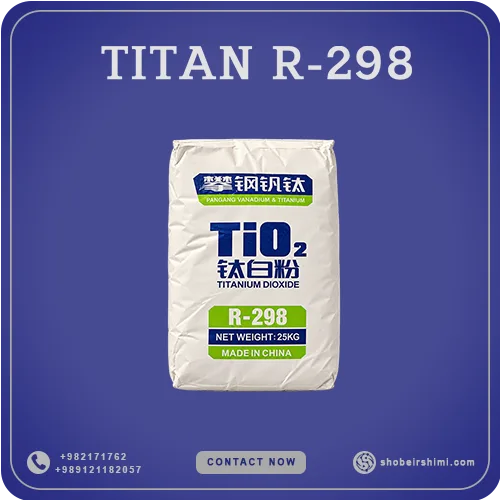
- Product: Pangang R-298 titanium dioxide.
- Pigment type: Rutile TiO₂.
- Production process: Sulfate.
- Surface treatment: Alumina and zirconia, with organic treatment.
- Optical characteristics: Bluish undertone and high gloss.
- Formulation characteristics: Good dispersibility and hiding power.
- Main application focus: Coatings and printing inks.
R298 titanium dioxide
Description
R298 titanium dioxide is a multipurpose rutile pigment from Pangang, produced using the sulfate process. It is used in coatings, printing inks and selected plastics applications where formulators need white pigmentation, hiding power and reliable dispersion. Pangang lists R-298 within its sulfate-process titanium dioxide range for coatings, inks, paper and plastics.
Shobeir Shimi is an international trading company and supplier of industrial raw materials. Contact our team to discuss Pangang R-298 sourcing, review the applicable technical documentation and request a quotation for your quantity and destination.
Key Features and Their Practical Value
Pangang describes R-298 as a pigment offering hiding power, dispersibility and weather resistance for coating and ink applications. These characteristics make it a candidate for evaluation where appearance and durability are important to product selection.
For a buyer, the useful question is how those characteristics translate into the finished formulation. A pigment should be assessed at the intended loading, in the actual binder system, and under the production conditions used at the plant.
When comparing R-298 with an existing grade, evaluate:
- Opacity at the same film thickness.
- White shade and tinted colour development.
- Gloss after application and curing.
- Dispersion quality and processing time.
- Viscosity during manufacture and after storage.
- Durability under the intended service conditions.
These checks provide a stronger basis for purchasing than comparing TiO₂ content alone. A laboratory result should also be confirmed in a production trial before a full material change.
R298 Titanium Dioxide Applications
The Pangang-branded product sheet identifies wood coatings, automotive refinish paints, printing inks, architectural coatings and industrial paints as recommended applications. It also describes use in plastic profiles.
Architectural and Industrial Coatings
For architectural coatings, assess coverage, shade and the required finish within the intended formulation. For industrial systems, include the actual substrate, application method and curing conditions in the trial.
Exterior applications require particular attention to the complete coating system. Pigment selection is one part of performance; the binder, additives, film thickness and exposure conditions also need consideration.
Printing Inks
In ink trials, compare opacity and colour development at the intended print film thickness. Check dispersion quality alongside viscosity, storage behaviour and print appearance.
A grade that performs well in one ink system should still be tested before transfer to a different resin, solvent package or printing process.
Plastic Profiles
For plastic profile applications, evaluate R-298 in the intended polymer and additive package. Check colour, distribution and surface appearance after processing. Confirm any application-specific requirements before selecting the grade for routine production.
R298 Titanium Dioxide Technical Specifications
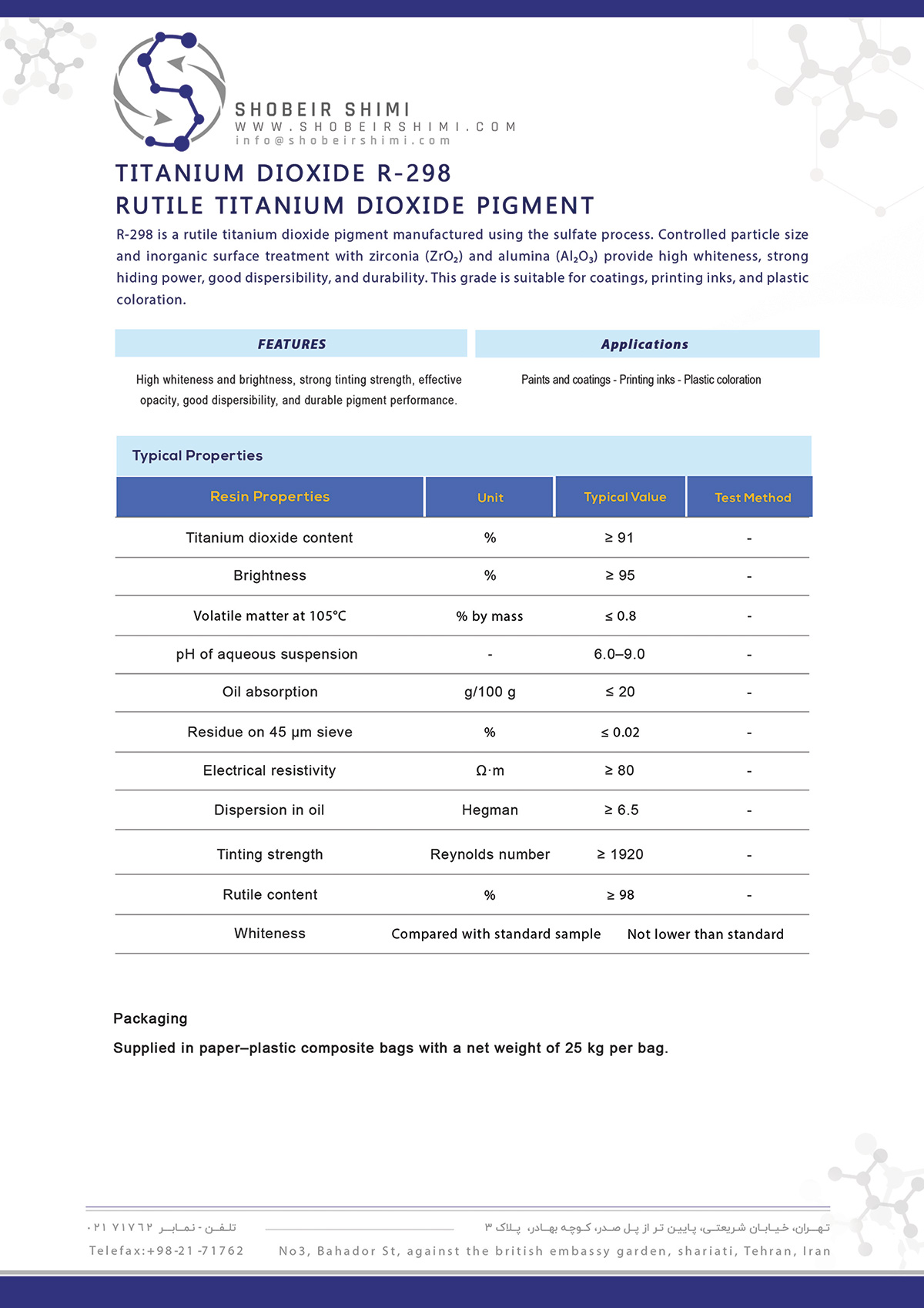
The following reference values come from the Pangang Titanium Industry product sheet, version 3.0, dated 20 February 2020. They are specification limits, not batch test results.
| Property | Value | Test Method / Reported Basis |
|---|---|---|
| TiO₂ content | ≥ 91.0% | XRF |
| Rutile content | ≥ 98% | Not specified |
| Brightness | ≥ 95% | Not specified |
| Tint-reducing power | ≥ 1920 | Reynolds number |
| Dispersibility | ≥ 6.50 | Hegman scale |
| Oil absorption | ≤ 20 g/100 g | Not specified |
| Slurry pH | 6.0–9.0 | Not specified |
| Electrical resistivity | ≥ 80 Ω·m | Not specified |
| Moisture at 105°C | ≤ 0.8% | Full method not |
| Sieve residue | ≤ 0.02% | 325-mesh sieve |
| Inorganic surface treatment | Al₂O₃ and ZrO₂ | — |
| Organic treatment | Yes | — |
Confirm the applicable specification and document revision before placing an order.
Dispersion and Formulation Evaluation
Treat a change to R-298 as a controlled formulation trial. Keep the main variables consistent during the initial comparison so that differences can be interpreted clearly.
Record pigment loading, addition sequence, dispersant selection and processing conditions. Compare the finished material with the existing formulation using the same test procedures.
The Hegman value in a pigment datasheet does not establish a universal milling time or equipment setting. Production conditions should be determined for the actual formulation. Likewise, this page does not prescribe a fixed dosage: the appropriate loading depends on the required appearance, application and formulation balance.
Packaging, Storage and Technical Documents
The referenced manufacturer literature lists 25 kg, 500 kg and 1,000 kg bags. Confirm which packaging is available for the proposed shipment. Store the product in a dry, ventilated location, protected from rain and direct exposure, and prevent contact with acids or alkalis.
Request the appropriate documents during procurement:
- TDS: Grade properties and specification information.
- COA: Reported results for the identified production batch.
- SDS: Handling, storage and safety information.
Check that the grade designation and batch identification correspond to the material offered.
R298 Titanium Dioxide Price and Supply
An R298 titanium dioxide price quotation should define more than the unit price. Quantity, packaging, delivery destination and agreed delivery terms determine what the offer includes.
When comparing quotations, check the technical specification, shipment scope and document requirements on the same basis. Confirm availability, minimum order quantity, payment terms and dispatch timing with the sales team for the particular order.
Shobeir Shimi provides a commercial contact for discussing material requirements and sourcing. Include any mandatory acceptance criteria in your inquiry so they can be reviewed before the order is finalised.
Frequently Asked Questions
What is Pangang R298 titanium dioxide used for?
R-298 is used in coatings, printing inks and selected plastic applications. The manufacturer’s application guidance includes architectural and industrial coatings, wood coatings, automotive refinish paints and plastic profiles. Suitability should be assessed in the intended formulation.
Is R-298 a rutile or anatase grade?
R-298 is a rutile titanium dioxide pigment produced by the sulfate process.
Is 91% TiO₂ the same as 98% rutile content?
No. They are separate reported properties. TiO₂ content describes the titanium dioxide content of the pigment, while rutile content concerns its crystalline form. The figures should not be presented as interchangeable purity values.
Can R-298 replace another titanium dioxide grade?
It can be evaluated as a candidate, but direct substitution should not be assumed. Compare optical performance, dispersion, processing behaviour and end-use properties through formulation trials.
What packaging and minimum order quantity are available?
Manufacturer literature lists several bag sizes. Available packaging and minimum order quantity must be confirmed for the specific quotation.
How can I request the R298 TDS, COA and SDS?
Contact Shobeir Shimi with the grade name and document requirements. For a COA request, include the batch number if known and confirm availability for the offered material.
Request a Quote for Pangang R-298
Send your required quantity, application, packaging preference, destination and preferred delivery terms to Shobeir Shimi. Our team can review your inquiry and provide a quotation with the relevant supply details.
مشخصات فنی
Reviews
There are no reviews yet.