
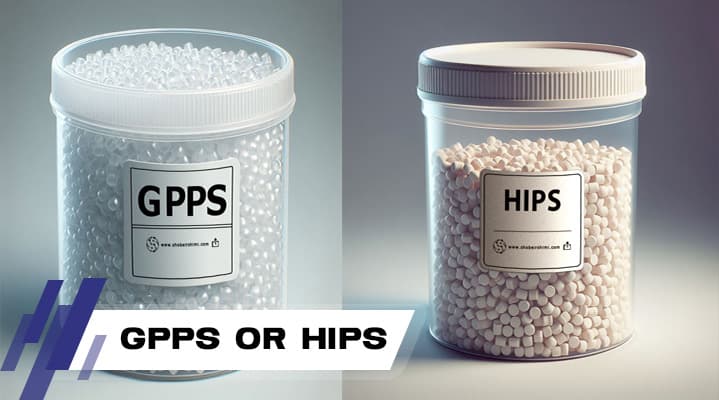
In the world of plastics, polystyrene stands out for its versatility and wide range of applications. Within polystyrene, two major types often come into play: General Purpose Polystyrene (GPPS) and High Impact Polystyrene (HIPS). While GPPS presents exceptional clarity, making it perfect for transparent packaging and displays, HIPS prioritizes toughness, offering superior resistance to impact. This comparative study thoroughly examines the characteristics of GPPS and HIPS, helping you decide which option best suits your needs.
Properties
- Transparency: GPPS is known for its excellent transparency, often described as having glass-like clarity.
- Brittleness: It is more brittle and has lower impact strength than HIPS.
- Cost: GPPS is generally more cost-effective than HIPS.
- Dimensional Stability: It has less dimensional stability than HIPS.
Applications
- Food Packaging: Due to its clarity, GPPS is widely used in transparent food packaging, such as disposable cups, lunch boxes, and confectionary trays.
- Household Items: It is also used in household dishes, CD cases, and cosmetic packs.
Toys: GPPS is famous for producing plastic toys due to its ease of molding into different shapes.
Properties
- Impact Strength: HIPS is known for its high impact strength and toughness, making it more durable than GPPS.
- Dimensional Stability: It has good dimensional stability, retaining its shape and size under changing temperature conditions.
- Color and Finish: HIPS is naturally white with a matte finish. It is not naturally transparent but can be easily painted and glued.
Applications
- Food Packaging: HIPS is used in food packaging applications such as yogurt cups and ice cream containers due to its impact resistance and ease of molding.
- Household Appliances: These produce refrigerator liners, toilet seats, and tanks.
- Automotive Parts: HIPS is employed in automotive interior parts due to its strong impact resistance and ease of manufacturing.
- Medical Devices: Due to its high impact resistance and low weight, it is used in various medical devices, including orthopedic splints.
Choosing the Right Plastic: GPPS vs. HIPS
Here’s a breakdown of the key differences between GPPS and HIPS to help you make informed decisions:
| Property | GPPS (General Purpose Polystyrene) | HIPS (High Impact Polystyrene) |
|---|---|---|
| Clarity | Crystal clear | Opaque or translucent |
| Impact Strength | Low (brittle) | High (less brittle) |
| Rigidity | Excellent | Good (may bend under pressure) |
| Dimensional Stability | Excellent | Good (may show slight variations over time) |
| Chemical Resistance | Good | Good |
| Cost | More cost-effective | Slightly more expensive |




Thanks for the article.
Could the durability of High-Impact Polystyrene (HIPS) be boosted by blending it with Ethereum-mining waste as a novel, eco-friendly, and potentially cost-effective approach?
That’s an interesting idea. In theory, blending High-Impact Polystyrene (HIPS) with certain recycled industrial waste materials could improve some properties while also reducing material costs and environmental impact. However, the final durability would depend on factors such as compatibility, particle dispersion, thermal stability, and processing conditions. Proper testing would be necessary to evaluate mechanical performance and long-term stability before industrial application.
Hello all, I recently joined and wanted to say hi. I found this community while searching online and decided to sign up after looking over a few threads. There’s plenty of valuable insight here, and it’s clear that many members have hands-on experience. I’m looking forward to spending more time and hopefully contributing. I have been learning about this lately.
Thank you very much for your kind and encouraging words! We are truly happy to hear that you found the article valuable and informative. It’s always rewarding to know that our content can inspire professionals and enthusiasts interested in the petrochemical and trading industry.
The petrochemical market offers many exciting opportunities in both local and export sectors, and we hope our articles continue to support your journey in this field. We also look forward to the possibility of cooperating with you in the near future.
Wishing you great success in your business activities and future projects!
I’m curious which websites and online portals people visit most frequently. Do you mostly use news websites, social media, forums, entertainment portals, or specialized websites related to your hobbies and interests?
Personally, I tend to visit a few websites regularly rather than constantly switching between different portals. I’m interested to hear what other people use on a daily basis and which websites they simply couldn’t imagine being without.
What are the websites you visit most often?
Hi everyone, just joined. I registered after reading a number of threads and noticing how informative the conversations are. The forum seems easy to navigate, which makes it more comfortable for someone new to find relevant information. I appreciate the friendly tone here and I’m looking forward to learning more. I have recently been learning about this recently.