
Prilled Urea is widely recognized as the most versatile form of solid nitrogen available in the global market. With a minimum nitrogen concentration of 46%, it serves a dual purpose: acting as a rapid-release fertilizer for high-value crops and a critical chemical feedstock for industrial manufacturing.
Whether utilized in the synthesis of Urea-Formaldehyde resins or applied in precision agriculture, the demand for Prilled Urea is driven by its exceptional solubility and chemical purity.
However, sourcing high-quality Prilled Urea requires more than just finding a competitive price. For procurement managers and industrial buyers, the priority is ensuring particle uniformity, low biuret levels, and supply chain integrity. This technical guide outlines the critical specifications, diverse applications, and strategic considerations for importing high-grade Prilled Urea N46.

Prilled Urea Granules and Grades
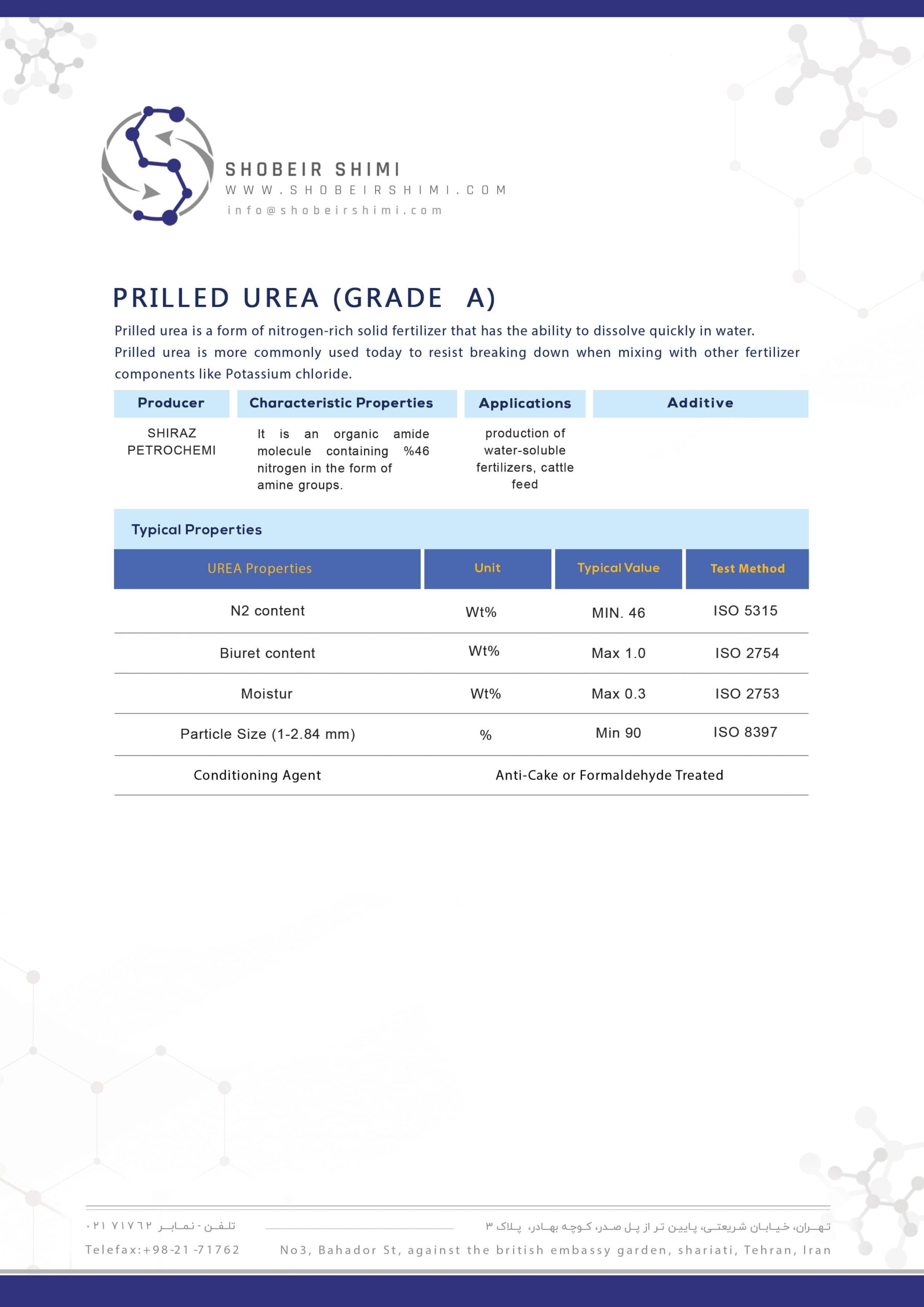
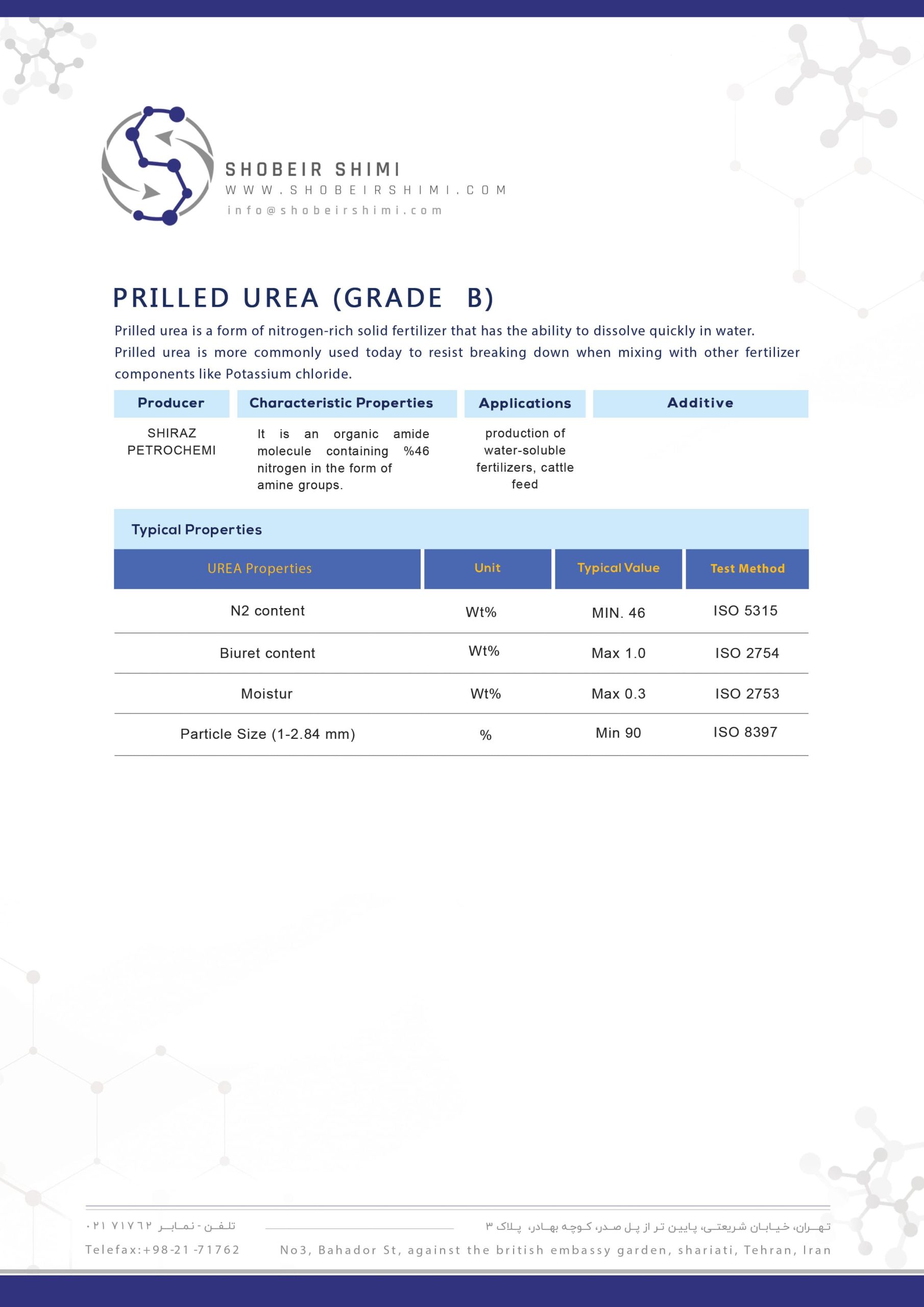
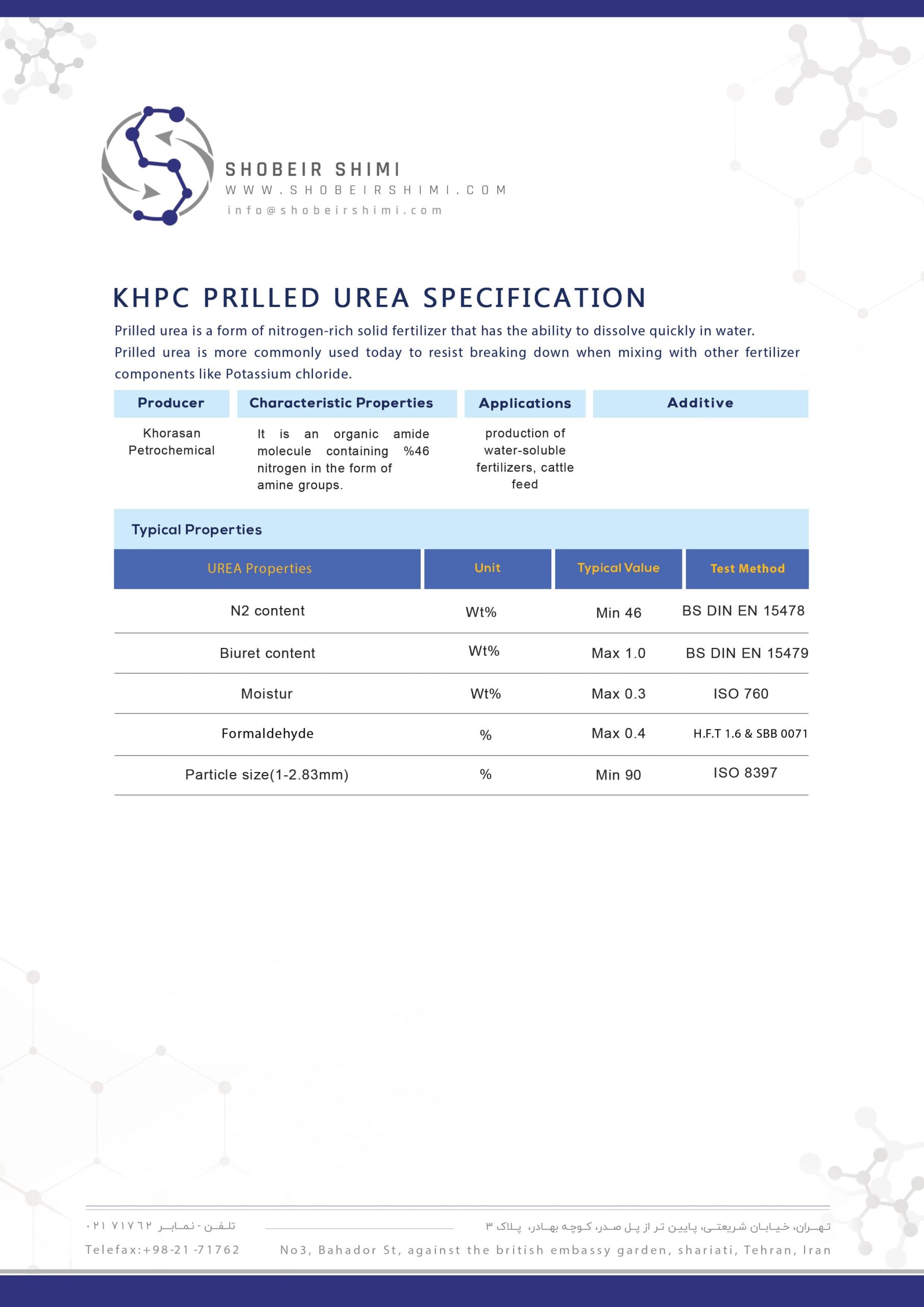

Manufacturing Technology & Characteristics
To understand the superiority of Prilled Urea for specific applications, one must look at the unique engineering behind its production. Unlike granulation, which builds layers, prilling is a process of pure melt solidification. This results in a product defined by high chemical purity and rapid solubility.
The Prilling Process: Precision Engineering
The manufacturing of urea prills occurs in a massive structure known as the Prilling Tower (typically 60 to 100 meters high). The process involves three critical stages:
- Melt Distribution: Highly concentrated molten urea (99.7% melt) is pumped to the top of the tower and forced through a rotating Prilling Bucket or specialized shower heads.
- Droplet Formation: The rotation creates thousands of uniform liquid jets that naturally break up into perfect spherical droplets due to surface tension.
- Solidification: As these droplets fall freely through the tower, they encounter an upward stream of cooling air (counter-current flow). This rapidly cools the droplets, solidifying them into small, smooth beads before they reach the collection floor.
Key Result: This method produces a sphere that is slightly smaller and softer than granules but possesses a smoother surface and uniform internal structure, ideal for fast dissolving.
Prilling vs. Granulation: What is the Difference?
Buyers often ask about the difference between prilled urea and granular urea. While both solidify molten material, the methods and results differ fundamentally.
| Feature | Prilling | Granulation |
|---|---|---|
| Process | Sprays molten material directly into a cooling tower. Pure melt solidification. | Uses binders to agglomerate (stick) powder particles together into layers. |
| Purity | Higher Purity: Only the melt is involved, with no binders needed. | Slightly lower purity due to the addition of binders/additives. |
| Strength | Particles have uniform strength but are generally softer than granules. | Granules are larger, harder, and more resistant to crushing. |
| Efficiency | More energy-efficient production. | Requires more energy for the layering and drying process. |
| Moisture | Less resistant to high humidity storage. | More resistant to moisture absorption. |
| Best For | Industry (Resins/AdBlue) & Foliar Spray | Broad-acre Farming & Bulk NPK Blending |
Technical Specifications & Data Sheet (TDS)
For industrial manufacturers and agricultural professionals, strict adherence to technical specifications is non-negotiable. Our Prilled Urea is produced to meet the highest international standards (including GOST 2081-92 equivalent), ensuring consistency in purity, solubility, and particle size.
Below is the comprehensive technical analysis for our Export-Grade Prilled Urea:
Standard Specification Table
| Parameter | Specification | Notes / Test Method |
|---|---|---|
| Nitrogen Content | 46.0% Min | High concentration N46 |
| Purity | 99.0% Min | Free from coating agents |
| Biuret Content | 1.0% Max | Critical for industrial use & cattle feed |
| Moisture | 0.3% – 0.5% Max | Low moisture prevents caking |
| Particle Size | 1.0 – 2.4 mm | 90% Minimum Uniformity |
| Bulk Density | 720 – 750 kg/m³ | (Approx. 45 lb/ft³) |
| Formaldehyde | Max 0.2% | Significantly lower than Granular |
| Iron / Heavy Metals | Trace / None | Suitable for chemical synthesis |
| Color | Pure White | APHA Units: 10 Max |
| Solubility | 100% | Rapid dissolution in water |
| Melting Point | 132°C | Standard physical property |
Detailed Analysis of Key Parameters
1. High Solubility & Purity
Prilled Urea is chemically defined by the formula CO(NH2)2.
- Water Solubility: It is highly water-soluble, with approximately 100g dissolving in 100ml of water at 20°C. This rapid dissolution rate (faster than granules) makes it the preferred choice for liquid fertilizers and industrial solutions like AdBlue/DEF.
- Chemical Purity: Unlike granular urea, which requires hardening agents, Prilled Urea is often produced as a “pure melt.” This results in lower formaldehyde content (Max 0.2%) and minimal impurities, making it ideal for resin and melamine production.
2. Biuret Content (Safety)
Biuret is a byproduct of urea manufacturing that can be toxic to plants and animals in high concentrations.
- Our Standard: We strictly control biuret levels to Maximum 1.0%. This ensures the product is safe for foliar application on sensitive crops and suitable for use as a non-protein nitrogen supplement in animal feed.
3. Physical State & Storage (Critical Humidity)
- Hygroscopicity: Urea is hygroscopic. The Critical Relative Humidity (CRH) at 30°C is 73%. This means if the air humidity exceeds 73%, the prills will start absorbing moisture.
- Handling: To combat this, our product is stored in climate-controlled warehousing and packed in moisture-proof bags with inner liners. The prills demonstrate excellent flowability (Angle of Repose: 34–35°), ensuring no clogging in hoppers or machinery.
Key Applications: Farming, Industry & Technical Solutions
The versatility of Prilled Urea drives its massive global demand. Unlike granular urea which is optimized for broad-acre spreading, Prilled Urea is prized for its rapid solubility and chemical purity. Understanding these specific applications helps buyers calculate the ROI for their specific sector.

1. Industrial Applications (Technical Grade)
Beyond the farm, Prilled Urea is a foundational raw material for the chemical manufacturing sector. Its high purity makes it the preferred choice for:
- Diesel Exhaust Fluid (AdBlue / DEF): High-purity, uncoated Prilled Urea is the essential ingredient for producing AdBlue. When dissolved in deionized water, it creates a solution injected into modern diesel engines (SCR systems) to break down harmful NOx emissions into harmless nitrogen and water.
- Resin & Adhesive Manufacturing: A significant volume of global supply is consumed by the wood industry. Prilled urea is reacted with formaldehyde to create Urea-Formaldehyde (UF) resins, which act as the binding agent in plywood, particleboard (MDF), and furniture.
- Melamine Production: It serves as the primary feedstock for synthesizing melamine, used in laminates, dinnerware, and flame retardants.
2. Agriculture & Livestock (Fertilizer & Feed Grade)
Agriculture remains a dominant consumer, but the usage differs from granular urea.
- Foliar Feeding (Spray Application): Due to its instant solubility, prills are the standard for creating liquid fertilizer solutions. Farmers spray this directly onto crop leaves for rapid nitrogen absorption during critical growth stages, without the risk of clogging spray nozzles.
- Greenhouse & Hydroponics: In controlled environments, the high solubility ensures no residue is left in drip irrigation systems.
- Animal Feed (Ruminants): Prilled Urea is widely used as a Non-Protein Nitrogen (NPN) supplement in feed for cattle and sheep. It helps rumen bacteria synthesize protein, improving digestion and growth rates.Safety Note: For feed applications, our urea is strictly controlled for low Biuret levels to prevent toxicity.

3. Specialized & Environmental Uses
- De-icing Operations (Airports): Prilled urea is a non-corrosive, biodegradable alternative to rock salt. It is extensively used for de-icing airport runways and bridges where utilizing chloride-based salts would corrode metal aircraft parts and concrete structures. It remains effective down to -6°C.
- Pharmaceuticals & Cosmetics: Used as a humectant (moisturizer) in dermatology creams and as an excipient in various drug formulations.
Why Choose Prilled Over Granular?
For these specific applications, Prilled Urea offers distinct advantages:
- Instant Solubility: Dissolves much faster than hard granules, making it essential for liquid mixes (AdBlue, Foliar).
- Purity: Often produced with fewer additives/hardeners, making it safer for chemical synthesis and animal feed.
- Uniformity: The small, consistent spheres ensure precise dosing in industrial batches.
Global Sourcing Guide: Logistics & Commercial Terms
Sourcing Prilled Urea in bulk involves navigating complex logistics and quality assurances. Unlike granular fertilizers, Prilled Urea is highly sensitive to moisture and physical degradation. Therefore, choosing a supplier with robust logistics capability is not just an option; it is a necessity.
1. Selecting a Reliable Supplier
When vetting suppliers, look beyond the price tag. A reliable partner must demonstrate:
- Direct Access: Sourcing directly from manufacturers (like Khorasan or Shiraz Petrochemical) to eliminate broker markups.
- Capacity: The ability to fulfill continuous bulk orders (e.g., 5,000+ MT per month) during peak seasons.
- Inspection: Willingness to provide SGS or Bureau Veritas inspection reports at the port of loading to verify quality and quantity.
2. Export Logistics & Shipping Terms
Our logistics team specializes in moving hygroscopic chemicals. We structure deals using standard Incoterms to suit your risk profile:
- FOB (Free On Board): We deliver cargo to the vessel at Persian Gulf ports (Bandar Abbas / BIK).
- CFR / CIF: We handle ocean freight and insurance, delivering directly to your destination port (Asia, Africa, LATAM).
3. Packaging: Critical Moisture Control
Since Prilled Urea absorbs moisture easily (hygroscopic), standard packaging is insufficient. We use export-grade solutions designed for long ocean transits:
| Packaging Type | Specification | Best For |
|---|---|---|
| Jumbo Bags | 1-Ton / 1.5-Ton FIBC with Double PE Liners | Industrial Buyers & Large Farms |
| Small Bags | 50kg Laminated PP/PE (Palletized/Shrink-wrapped) | Distributors & Retail |
| Bulk | Loose in bulk vessels (Requires dry climate reception) | Massive Industrial Orders |
Market Insights: What Drives Prilled Urea Prices?
The price of Prilled Urea is dynamic and influenced by three global factors. Understanding these helps you time your purchase:
- Energy Feedstock Costs:
Urea production is energy-intensive. Since Natural Gas accounts for ~70-80% of production costs, fluctuations in global gas indices directly impact the FOB price.
- Seasonal Agricultural Demand:
Prices traditionally spike during major planting windows in the Northern Hemisphere (Spring) and Southern Hemisphere (Fall) due to fertilizer demand.
- Freight & Logistics:
Ocean freight rates play a significant role in the final CFR/CIF price. Working with a supplier who has volume contracts with shipping lines can save significant costs.
Conclusion
Prilled Urea N46% is more than just a commodity; it is a vital input for high-yield agriculture and essential industrial sectors like AdBlue and Resins.
In a market defined by volatility, Shobeir Shimi stands as your stable partner. We bridge the gap between Iran’s world-class petrochemical complexes and your business, ensuring:
- Uncompromised Purity (Technical & Ag Grade)
- Secure Logistics (Moisture-controlled shipping)
- Direct-from-Source Pricing
Secure your supply chain today.
Contact us for the latest technical datasheets and competitive shipping schedules.
FAQ: Frequently Asked Questions about Prilled Urea
- What’s prilled urea used for?
- Mostly, it’s a nitrogen source for crops—helps plants grow strong. It’s also used in making resins and adhesives for industrial stuff.
- Is prilled urea better than granular urea?
- Depends on what you’re doing. Prilled urea dissolves fast, so it’s great in liquid mixes. Granular urea, on the other hand, works better for blending with other dry fertilizers or spreading with machines.
- How much nitrogen is in prilled urea?
- Standard prilled urea is 46% nitrogen (N46). That’s a solid nutrient punch for both farms and factories.
- Can you use technical grade urea on crops?
- You can, and it’s usually purer. But it’s pricier than regular fertilizer grade, so most people save it for special applications or precision farming.
- How do you actually buy prilled urea?
- Start by asking for a quote based on how much you need. Get the specs (TDS), make sure they match what you want, then set up the shipping—usually CIF or FOB.